Commercial, Corporate and Architectural Photography

Putting Your Best Face Forward


So you have decided that you need to update your company’s portraits. Now what? What images are going to show your company in the way you want and what will the images say about you? Not an easy question.


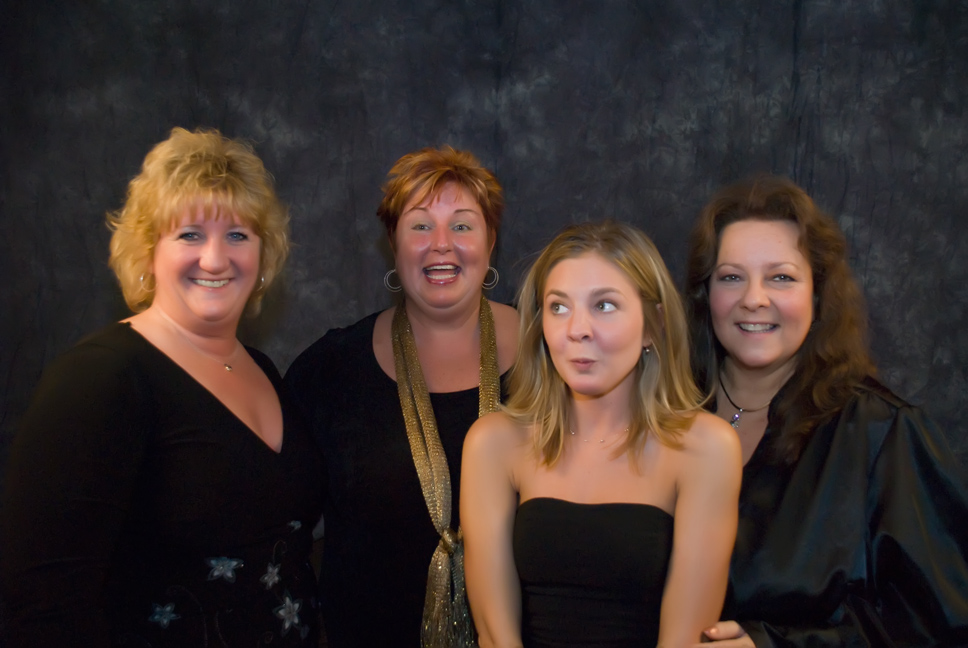
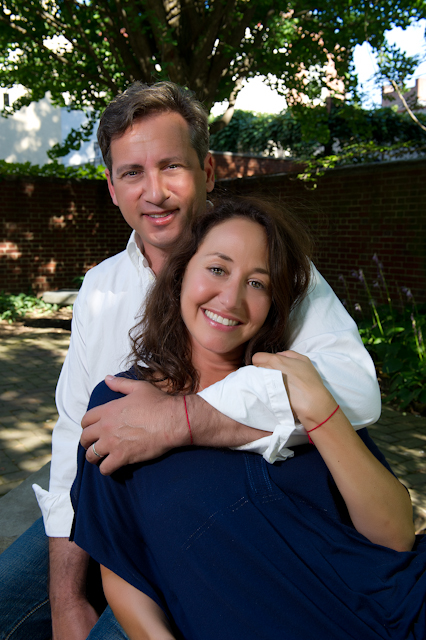
The hardest step has already been taken; you have made the decision. I mentioned in my last post the questions to ask to find the right photographer. Now that you know who you want to capture your company’s face, what type of images?  There are the good old group shots where you have the entire company empty out into the parking lot and stand together, perhaps waving or holding up a banner with the company’s logo or tag line, but that style is a bit dated IMHO.

Learn more and Read more

Questions To Ask Before Hiring A Photographer

At some point everyone hires a photographer or knows someone who will. In many cases it is a portrait or wedding photographer. At other times you may need a photographer to shoot images for anything from real estate to advertising. So how do you know which one is right for your needs?


Most people start out by asking friends, family members or colleagues. You are looking for references and that is the first question you should ask. Does he/she have references? Every professional should have references, especially photographers. But let’s be honest, if you ask me for references I am not going to give you a clients name where we didn’t get along. I am going to give you 3 – 5 names that I think were my best combination of results and compatibility. I want to put my best impression out there after all.


When seeking references, don’t just go by what the photographer says. Before you even ask them for references, look at their website. Do they have a client list on the site? Wedding photographer usually don’t but most commercial photographers should. By looking up those clients and making only a few phone calls you will learn more about the photographer than contacting all the ‘best’ clients he/she uses as references. When you call the clients just ask for the person that handles the advertising. Make sure though that you mention that you are looking for a reference and not looking to sell them advertising! Otherwise you may end up in someone’s voicemail and never actually talk to anyone.


Another question to ask is one for yourself. Do you like their work?  Is the quality of work up to what you want and need? Is the look and feel of the images in the portfolio what you want for your images? I know that I love the work of Joe McNally, Chase Jarvis and Michael Grecco. I think their portraits are outstanding. But if I need images of the corporate tower my company just built or the complex I just designed they may not be the photographer that I need. Make sure the portfolio has the types of images you need. If you need portraits, look at portrait photographers, wedding photographers for weddings, or architectural photographers for structures.


That leads me to the next question. Where can you find the photographers that do the work you want them to do? Of course the first thing many people do is Google “Photographer”. If you just search on ‘photographer’ you will get over 84,000,000 hits. That is not narrowing down the field. Architectural photographer and wedding photographer get 531,000 and 5,070,000 hits respectively. Of course adding your city is going to narrow those results dramatically but you are still going to end up with hundreds, if not thousands of names. If you only look at the first page of each search, you will have only 10 to choose from, but are they the best?  Well they are the best at search engine placement, but are they the best photographers?


The best place to find a photographer is where they hang out. Serious photographers like to hang out with other photographers and many are listed in the associations for photographers. Some of the larger associations have a “Find A Photographer” search engine on their sites. Here is a list of just a few of these groups and their websites.


Association Web Address
Professional Photographers of America (PPA) www.ppa.com
American Society of Picture Professionals (ASPP) www.aspp.com
American Society of Media Photographers (ASMP) www.asmp.org
Advertising Photographers of America  (APA) www.apanational.com
The Association of Photographers (AOP) UK www.the-aop.org
Australian Commercial and Media Photographers (ACMP) AU www.acmp.com.au


Does the photographer you have selected have the equipment needed to do the job correctly? Different types of photography require different tools. Professional equipment comes in all sizes shapes and colors. I can get great results when I use a point-and-shoot consumer camera but will that image transfer to the a billboard sized image as well as it will to the internet? Does the photographer have the ability and tools to control the light properly? Do they have access to a studio appropriate for the shoot?  Shooting toy cars requires much less space than shooting a real car.  Are they going to get the image right at the shoot or do they tell you, “I’ll fix it in Photoshop later.” Post production is a requirement for almost every image, don’t get me wrong; however, post production is the refinement of color and style, not the solution to all problems.


Professionalism is also a very important. Almost every photographer has gotten into the business of photography because of their love of the art. I don’t know any business people that became photographers because it was ‘a great business venture’.  The photographer may be well equipped, they may be able to capture the exact image you need; but that is all irrelevant if the image is delivered late or unprofessionally. You need a photographer who understands your needs and appreciates your business. They have to be willing to listen to you and your needs and translate them into the imagery you want.


Last, but definitely not least is how much should you pay for a good photographer?  Photographers can range in price from a few hundred dollars an hour to tens of thousands. Experience, talent, knowledge and vision all are parts of the cost. These are the intangibles. The tangible is the cost of the studio, the models, the actual products, etc. Add them together and you have your cost, not your expense. The expense is almost irrelevant if you do an advertising campaign that doubles or triples your bottom line. Yet if the same campaign costs you your loyal customers or has little or no return, the expense can be huge.  Put out the wrong image and it can cost you your entire business. For portrait and wedding photographers it comes down to the value of your memories. What is the value of an image if that is the last image ever captured of you and [fill in the blank]? That image is priceless.


The question then is not what you should pay but what can you afford? The images you receive back are investments plain and simple. Just like any other investment they should be planned for and budgeted for. A poor investment results in a poor return. A wise investment can change your world in a positive way. Can you put a price on that?


Until next time…

Questions? What About Answers?

Answers. Hmm… Seems like many people have nothing but questions anymore. What about answers? You would think that with the internet and sites like About.com, Answers.com and of course Google, answers would be easier to find. If answers were so easy to find why are there sites like Question.com?


I certainly don’t have all the answers. If I did I surely wouldn’t be sitting here writing this! But I do know a thing or two especially about photography. I can tell you how to take a picture, what f-stop to use, what lens might be best for a certain situation and what lighting to use. But if you could make the image that you need you wouldn’t be reading this would you? Or maybe you can but you just don’t have time. Time, it is a four letter word. But I digress.

Board Room at Day & ZimmermannYou have questions, more importantly, you need answers. Perhaps it is because of time; recently we all have to do more. Perhaps you are doing the job of 3 people or more, you just don’t have time to get the answers. Well, I am here to help.

I take time to work with people. I spend the time and the effort to learn what your project is and what it can be. I will work for you and with whomever you need me to so that you can get the images you need with as little energy as possible. You have other things to do.

You have so much on your plate that you don’t have time to learn look at the minute details of each project. That is what you hire people for. I can work with them to bring you the imagery, the vision of the extra special details that make your business better, the reasons your company is special.

Having many years experience in both the corporate and photography worlds I know what it’s like to have too many irons in the fire and trying to get it all done in the shortest time possible. Sometimes you have to do this not knowing exactly what is needed and you have to trust your people, your contractors, and your vendors to know what it is that you need. I have spent years learning how to gather the information needed to translate ideas into images. I know what it is to capture the meaning of an event, the mood of a location and the details that make an image special. Special enough to carry a message. Your message.

I take the time to work with my clients and to build relationships with their staff to help them understand what they want and need from their imagery, the imagery that is going to drive home your message and make your clients say, “Wow!”

When was the last time you sat down with someone that listened just because they wanted to help? Help is what I do. I help my clients get the results they want, help them go beyond the need and on to the place where that something extra special grows. It’s all in the details. Let me capture them for you. Then maybe you can deal with that four letter word, Time.

Until next time…

Happy Shooting!

Doing A Great Job

Recently it was suggested to me to change the direction of my blog. The thought was that I was writing more for other photographers rather than my potential clients. To be honest, the person who suggested that was probably right. Let’s face it, my clients (I hope you are one of them) don’t want to know how to create the James Effect or Make an Image Pop! That’s what they hire me for. (I hope!)


In addition they suggested that I do a blog post about the differences between “a job well done” and a “great job!” I am going to be honest, I gave up after 7 tries; well sort of. This is actually number 8. I think I figured out what I was doing wrong, I wasn’t writing like I usually do. I usually write like I am having a conversation. That isn’t what I was doing with attempts 1 thru 7.


I’ll admit it, I can write about what photographers want because I know what I want. When was I try to write to you my potential client, I was trying to be you. What do I want an article from a photographer to tell me about the photography he thinks I need. Answer? Nothing.

I can’t tell a client what they need, I can only listen to them tell me what they want an image to do. Perhaps they want an image to translate an idea or a concept. Maybe it should reflect a lifestyle or a way of living. Or maybe they want a series of good portraits of the leaders in their company. It is not my job to tell them what they want or need. It is my job to go out and get it. Not just to get the shot but to go out and get the feeling they want and need.

I was trying to write to potential clients to tell them why they needed me to take an image for them. The truth is that they don’t need me to take an image for them, anyone can do that. Anyone can pick up a camera and take a snapshot of horse in a field or a picture of a house. A decent photographer will capture an image that shows the colors of the horse in contrast to the green fields or a well lit image of a nice home. That is a job well done.

But that isn’t what I do. I make images that show a lifestyle. Images that show what it is like to live in the country. Images that make you and your clients want to have a stable, not just own a horse. I want to create an image campaign with you so that we, as a team, can have your clients feel what it’s like to come home to luxury or to be pampered and treated like a movie star when they are doing a promo piece for their next movie release.


That is what I do. I make images, not take pictures. And I do a great job, not just a job well done.


Until next time…

Photography – When ‘Good Enough’ Isn’t

When is “good enough,” good enough?  Hell of a question to ask a perfectionist. But the real answer is actually easy. Good Enough is never good enough.


Seriously though, many businesses think that imagery, video or stills, can be done for less that it traditionally has been done. Because of this many marketing directors and art directors are forced to settle for smaller budgets. They try to make do with less. Less is not more in photography. Less is just, well, less.

Your product or service isn’t just good enough is it? Isn’t your advertising supposed to show your best side, show how you stand above your competition? Let’s look at a few examples. We will get to my images later but first go to Google.com and type in “sneakers” and click the first link that pops up. Top of the list, #1 ranking. Go ahead. I’ll wait. That was fast. Not a bad site, rotating images of, well, sneakers. Now go to Nike.com. I’ll wait. No problem I have time.


When you’re done, I’ll be here.
Wow! Once you get past the language and country, now that is a photograph!  Time was spent conceptualizing and capturing that image. And you have to click to move to the next image. But you want to. You want to see what is the next shot, what do those sneakers look like. They got you. They have you looking and reading and you are curious. Isn’t that putting your best foot forward? (pun intended)


Seriously, the idea of marketing is to set yourself above and beyond your competition. So how is “good enough” setting you apart? If you are just doing something as good as the other guy, why do I want to use you instead of them? What makes you special? Nothing. So I am sticking with them and you just wasted your marketing dollar.


The fact is that by not doing the best you can, you actually waste more money that you think. First you are wasting it on an image that isn’t putting you in front of the pack. That dollar you did spend is possibly killing your entire marketing campaign! You saved a few hundred or a few thousand by hiring your brother-in-law’s kid who has a decent camera, but no training or skills, and you got a shot that is good enough.


Now you put your marketing campaign out there and it doesn’t bring you any new business. What if you get images that are really just average or even above average snapshots, you may even lose a few points of your market share. After all, your version of a Nike type competitor did spend a little more and hired the same pro that did the Nike website images. Now he has your customers. You lost even more.  These images are getting expensive.


You have spent money on your nephew, you spent money on the marketing materials and ads. Maybe you have a marketing department. Well those people don’t work for free. You spent thousands, maybe tens of thousands on a marketing campaign and put in good enough images and now it cost you more than if you did nothing!  You lost all those customers to save a few bucks!


OK let’s say you’re not a business man. You’re just the average Joe working for a living. Maybe good enough is good for you. Probably not. In fact, for you it’s even a bigger hit. Imagine if you hired Uncle Louie to shoot your wedding because you wanted to save a little bit more for the honeymoon. Your images came back flat, lifeless and half the people had their heads cut off in the middle of their foreheads. Your married now and she isn’t happy about those images. The wedding album is on her side of the bed. You’re not.


OK you sprung for the pro photographer at the wedding but you didn’t want to get the baby pictures done by the professional. Guess what. Kids grow up and they do it fast.  Before you know it you’re paying for college tuition rather than diapers. Those first few years aren’t coming back either. You missed the best shots of their lives.


So when is good enough, good enough? Never.


What about those images of mine I said would come later? Check out the portfolio here: https://michaelalbany.com/portfolio/ and tell me. Did these people settle for good enough?


Why are you?


Until next time…

Happy shooting!

Breaking the Rules


As many of the regular readers of this site know, I am a huge fan of HDR (High Dynamic Range) photography. I love how you can create images that really pop and have deep, rich saturation of color.  In many cases, it can be over done to the point of surreal and almost (and in some cases, very) unrealistic. Many believe this is the only way to do HDR; it is the “HDR Rule.”


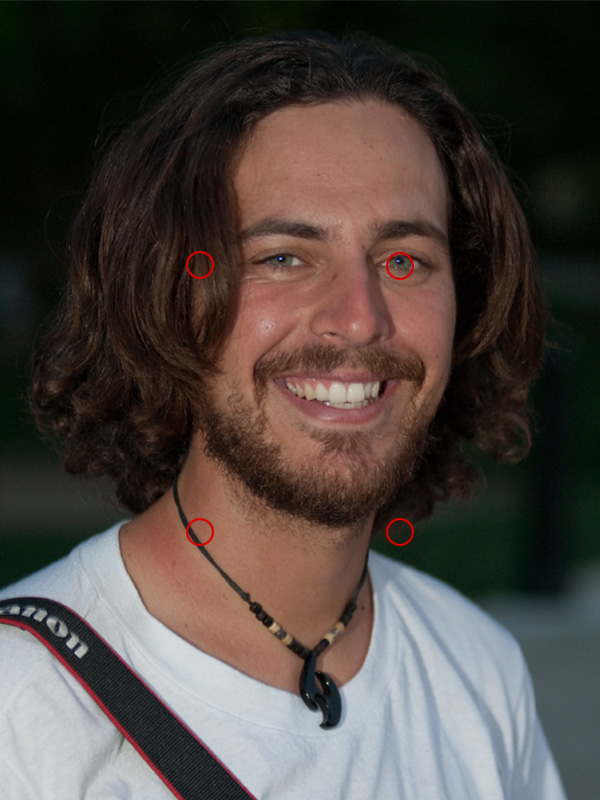
Another rule is the Rule of Thirds. In the rule of thirds the thinking is that you should divide an image into thirds or 9 cells as the image below shows. In the final image that you present it is strongly suggested that pour points of interest (POI) should be along those lines and even better, where they intersect (the red circles).


This rule is not a hard fast rule but one that is “strongly suggested.” Many images you have seen break this rule.  More however, almost break the rule. They way they will do this is to place a person into the image center but keep the eyes on the third mark and perhaps place one of the eyes over the POI intersection.  The latter is usually done by using a fast lens (2.8 or 1.4) and keeping the depth of field so shallow that one eye is softer and less sharp than the other eye. The sharper eye is then placed over the POI intersection to grab your attention.

This image I took this past weekend of a really nice guy I met in DC while shooting the Lincoln Memorial is a perfect example. Victor is from Holland and I have to give him a nod as he is traveling the US before starting his career this come summer. If all Dutch are as intelligent and friendly as Victor I am moving. Enjoy the rest of your trip Victor!


Anyway, back to my point. The image above shows Victor in the middle of the shot, however his eyes are on the top third parallel. In fact, his left eye (on our right) is exactly over the upper right POI. I superimposed the first image over Victor to show what I mean.


Obviously the image of Victor is not HDR. But whether your image is of people, still life or anything this rule is applied more often than not. The same is true of the over saturation and uber sharpening of what is called HDR. The reality is that HDR is High Dynamic Range, not High Reality Delusion.


In the image below I break another rule too. The rule that, “The horizon line should never divide the image in half.” This is just a variation of the rule of thirds so I won’t go into it again. Keep in mind this image is a composite HDR image made up of 4 separate images processed in the same fashion that I mentioned in my last blog post. Let’s look at the rules that have been broken here.


  • HDR Rule of Surrealism
  • Horizon Center Division
  • Rule of Thirds (sort of)


In fact, although I did separate the image in the center with the edge of the reflecting pool, and I created realistic saturation, I didn’t really break the Rule of Thirds. In fact, I multiplied it. Notice the Capitol Building. Not only is it the main subject in the upper third of the image, but so is the reflection of the building in the lower third. This actually broaches on another rule of only having one main subject per image. In fact, I do have only one main subject, I just have it twice. Does that break that rule too?

The main point of this post is simple. Rules are meant to be broken. The idea is to know the rules so that when you break them, you have a reason and purpose in doing so. Take the time to learn all the rules you can, study how they work, then go out and break them to show only a positive result.


How are you going to break the rules today? Leave a comment to tell us.


Until next time…

Happy Shooting!

HDR Images – Photomatix to Photoshop


On my last tutorial I showed you how to generate a good HDR image from Lightroom to Photomatix then to Photoshop. I got a few comments saying “I don’t use the plug-in!” or “I don’t have Lightroom!” Well, Photomatix is a standalone program too. So in this 3 part series of video tutorials I will walk you through the entire process starting in Photomatix and ending in Photoshop CS4.

This tutorial is a little longer than the last one totaling just under 30 minutes for all three parts combined. You may want to sit back and grab a cup of coffee before you start. I don’t think I sound boring, in fact I was surprised how long it took to get through it all because it felt like a lot less than that when I recorded it. Click the image below to watch part 1 then come back and watch the second two parts!

Part 1

Click the link below for parts 2 &3!
Read more

Appearance! By me of all people!

I will be showing some of my work at the FRESH GROUND COFFEE HOUSE in Willow Grove PA this coming Friday evening July 24th from 8pm until Midnight! Fresh Ground was put together by a friend of mine in a wonderful little church in Willow Grove and they had their first one last month. I attended and the church wasn’t struck by lightning. Amazing!

You can get all the details on Facebook.com (just click here to check it out) but I can tell you that there will be live music from Bill Haney and Friends, fresh coffee, good people, conversation and you can see my work all for free! I like free, free is good. If you’re like me and thinking, “they are going to go all religious on me,” don’t worry. Last month the only time I heard the ‘G’ word was when someone stubbed their toe and that was followed by a word other than ‘bless’.

I look forward to seeing you there! Yes, you.

To leave a comment, click the link below.

So you’re here. Maybe its not Friday yet, maybe it has past and you came by and said hi. Leave a comment and tell everyone else what you think.

Happy Shooting!

What Camera should I get? Part IV (and final)

A couple of weeks ago I started composing my first ever blog post. After I sat down and looked at what I had written I saw a long boring, uninteresting article that lacked any quality at all. At that point I was asking myself what I was getting into. I had just started a blog and dang it, I needed content.

The reason was that I glazed over important topics. When I started re-writing with my girlfriend/editor looking at each article, I took her suggestions and the article got longer; a lot longer. Those edits became the previous posts. This is where I wanted to be: DSLRs.

With DSLRs there are many manufacturers. We can discuss the greatness of each, but why? All that will do is create more ‘camera wars’ (for those that are not familiar, camera wars are much like computer wars. PC or Mac? Nikon or Canon or Sony or Pentax or…? Same fight, same result; none.

For the most part I am going to mention Nikon or Canon because that is what I know the most about. The fact remains that when you get to this level of equipment you are spending a large amount of money. Will they take better pictures for you? Not for you no. But if you take the time to learn how to use the equipment and what it can do, you will have the opportunity to take better pictures.

When you get a DSLR system you are getting just that, an entire system. That brings us back to that question again; “What are you going to photograph?” Also another question comes to mind: Do you have some old Nikon or Canon lenses lying around? Will they work with a new camera body? If those lenses are less than 25-30 years old there is a good chance they may. There is also a good chance that even though they will work, they will do so only in manual mode or at least not give you access to all the features of your new digital SLR.

The true question comes down to not what camera body you buy, it comes down to what lenses. After all you will change camera bodies over and over again throughout your lifetime. And usually when you buy into a system you tend to stick with it. You could change over to another system frequently if your last name is Gates and your father is in the software business.

Camera bodies are the brains of a system; well, the one other than yours. Like yours and my brain they get smarter. But unlike us, cameras don’t just look at a scene and say “hey, I shot this last time at F11 and you know I probably should have used F32”. Well they don’t do that yet anyway. That is your input. The camera only knows how to calculate the scene before it in a certain way unless you tell it not to. What also makes the camera see a scene differently is the lens. Each lens sees every scene in its own way. That is why there are so many different lenses, so you the photographer can interpret the scene the way you want the viewer to see it, not how the camera wants to see it.

Although lenses are dumb, they cost a lot of money! They see a scene in one way. The only change is by the setting you make on that lens, but F22 or F11 or F2.8 is always going to require a certain amount of light at ISO X and an exposure of Y. That never changes. Lenses are dumb. But good lenses see that scene exactly the same way every time the same way and at the same settings. Always. It is what you can count on. It’s what they do and they may not do anything else, but they do that and they do it well.

Remember, the manufacturer is going to come out with the new and improved camera next year that is just so much smarter and can do so much for you that you just have to have the newest, best, most current camera out there! After all it’s the new and improved version, right? That is why the lenses are the most important investment you will make, because you only want to make it once.

To get you started on your journey, take a look at these two sites; http://dpreview.com/ and http://www.steves-digicams.com. These two sites have more information than I can swallow in one sitting. They both are independent and have great information about almost all cameras out there. You can do a Google search on ‘camera reviews’ and you will get 73,200,000 hits. These two are the first three for a reason.

That wraps up “What Camera should I get?”

Until next time, Happy Shooting!

What Camera should I get? Part III

Ah yes, the wonderful mystery of the megapixel. Cameras come in all sizes, and all amounts of megapixels. So how much do you need? Is ‘more’ better? Size does count, but not the way you think. If you are printing just the standard 4×6 inch (10×15 cm), almost all cameras will be fine; the standard is fast becoming about 5mp (megapixels). You can get up to 34mp for about $35,000 if you want it, but do you need it? Probably not. You can print up to an 8×10 inch photo with little or no pixel distortion (depending on the subject of the shot, maybe a little larger).

The question actually comes down to the size of the sensor, not how many megapixels. If you want to print larger than 8×10 you want to consider more pixels, but if you want to print sharper at any size you want to go with a bigger sensor.

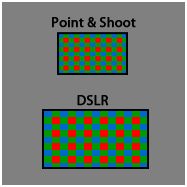
Image Sensors

In this image you see two representations of sensors. One is for Point & Shoot cameras and the larger is to represent DSLRs.Now they even make what is called a full frame sensor. The full frame sensor is the same size as the old 35mm film negative. The point is that if you project an image on both of the sensors shown, you can imagine that it is going to be reproduced in better detail with a larger sensor simply because it captures more color information. The more information your camera has to work with the sharper the image. So it’s true! Bigger is better!

This is a very simple explanation and overview, but it gives you the idea, no matter what she tells you that size does matter!

In part IV of the series I will get deeper into DSLRs and what to consider when buying a ‘system’.

Until then, Happy Shooting!
“Magick” Michael