Do I Need A Professional?

Many times I don’t hear the question “Do I need a professional?” but I do know that many clients and potential clients ask the question, at least of themselves. The answer is, to be honest, not always. But if you want the quality that either creates memories or helps you achieve your goals, yes you probably do. Making the decision to hire a pro is actually rather easy to answer. The real question is how do you find the ‘right’ photographer for your project.

The task can be daunting to say the least. With the popularity of digital cameras and their ease of use there are so many more photographers now than there ever has been. Some are good, some are great, some aren’t. So what makes one photographer better than another? Of course there is always the matter of style. This, like many other things, becomes a matter of taste. But certain skills are consistent in all good photographers whether they are an amateur or pro. The biggest is the understanding of light and composition. Even composition is a matter of taste to a point. So it comes down to light and the understanding of how it can work for, and against, you.


The study of light is critical in creating great images. The subtly of shadow and light can make or break an image in so many ways. An image needs to create a mood or emotion to be successful. The balance of positive and negative space is not just a matter of the balance of the image but more of a balance of the image and the message you are trying to send.


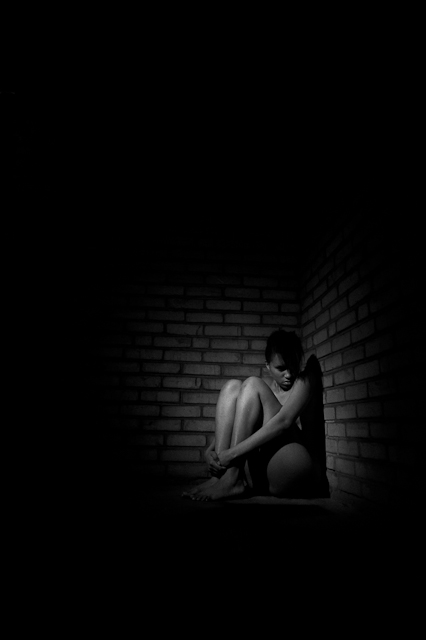
Each image can have its own message as well. The image included here tells a story but only enough of the story to make you want to know what happened: why is the woman in the image hiding, what caused her to feel so vulnerable? Technically this image could be criticized for too much negative space, being too dark, or any number of things, however the image does make the viewer wonder.


Being able to use light and dark, shadow and highlight; understanding how light and the lack of it can tell your story or send your message is what defines one photographer over any other. Being able to do that and understand your needs is what makes a professional.


What story can I tell for you today?
They Can Take Your Investments, But Not Your Memories

I just got back from a road trip with a client where we had 3 shoots in 2 days in 3 cities.  Oh, and one flat tire. It was a great trip and a fantastic shoot!  During the trip we covered a lot of miles and a lot of roads – over 600 miles to be exact. On almost every road, around every turn, we saw signs of the times: real estate “For Sale” signs.


The neighborhoods changed every few miles; small homes, big homes, estates and even condos but the single thread going through it all was those signs. All I could think of was how hard it was when I sold my house just over a year ago. I had a very small place where I used the basement as my studio.  It had a small back yard but a nice deck I had put on, and with all the problems you have with a house the best part was that it was mine.


All those for sale signs reminded me of why I created the Estate Legacy Products that I offer.  More and more people are selling the homes that their children grew up in. The memories are still alive and well in these places: the idea of the children running around the yard, perhaps a brother tormenting a sister with a frog or some other reptile, then that same scared sister putting a bandage on the scraped knee after the brother slipped and fell all live large in the memories of our parents and ourselves. Where are those memories going to be when that home is gone?


Often our parents have resigned themselves to letting the house go. We hear them saying that “it’s too big. It was different when you all were kids.” Or they say something like “Your dad doesn’t feel like keeping up with the yard work anymore. He would rather go play golf/fish/read/etc.” In their mind that’s very true but at the same time it would be nice if they had a way to take those memories with them.


With the economy the way it is today who can blame them?  Their home is all they may have left at this point. The investment they made 30, 40 or 50 years ago is still worth a lot more than they paid for it. Their financial portfolio, that probably isn’t doing as well. However if they sell the property they may be able to weather this financial storm. But what about all those memories?  How do they save the investment they made in you, your childhood, the education and most of all their family?


That is why I came up with the Estate Legacy Products. This is my way to help people find a way to preserve those memories and to document what was. Through my photography and special way of capturing the feel of your home I, along with one of my writers, document not just the house but the home and its history, its legacy. I can incorporate family photos and old pictures of the house and property with the new images I create. The writer will sit with members of the family and write a brief history to go with all the imagery and I combine that into a personal book that becomes more than a keepsake; it becomes a living physical representation of all your memories.


Give me a call and ask me about how I can help you preserve your family memories for generations.

Paying the Photographer

Photography has many different categories and business models. There are photographers for weddings, portraits, seniors, events, architecture, commercial, fashion, nature, fine art, stock, the list can be virtually endless; if you can think of a category I can probably name a photographer that specializes in it. With each specialty there seems to be a different payment method and in some cases it makes total sense.   A portrait photographer probably should be paid at the time of the photo shoot and a wedding photog should get 50% down to book the date and the balance the day of the wedding. But when these payment models are applied to other types of photography I begin to wonder.


I specialize in high-end estate and portrait photography but that is not the only work I do. I have different payment terms for each part of my business. Also how I get paid depends on who I am working with, not just the type of photography I am doing. If I am doing portraits for an individual, model or just regular family type portraits, I need to be paid at the time of the shoot. The reason is simple; I may never see that client again. They can just up and disappear.  Corporate portraits are a different story.

When I am doing corporate work, whether it is for the annual report or headshots for the company website, I don’t expect payment upfront or at the time of the shoot. I can do a Purchase Order (PO) or just a straight up billing at net30, depending on my client’s accounts payable model, not my billing model. I work with you not against you.


I understand how business is done and that does not usually mean getting paid up front. Many vendors feel that they should be paid at the time that services are rendered rather than when the final product is delivered and I understand that but that isn’t normal in the B2B world. For the longest time things like POs at net 30, 60 and occasionally 90 were the norm. Today there are corporations that are demanding net 180! Really? Net 180? Ouch!


Net180 has multiple purposes and it’s not because they don’t want to pay their bills. This is usually for very large corporations and what they are doing is trying to qualify their vendors and filter out the little guys that can’t carry a burden for 6 months. The odd thing is that many of the smaller vendors actually do this all the time; at least some photographers do. Stock photographers carry a net180 or more all the time. They shoot with no idea when, or even if, they are going to get paid. Many a stock photoshoot has sat for long periods of time waiting for those one or two clients that need that image. Stock images don’t make themselves; good stock images are made by good stock photographers who have the ability to see the future of the client’s needs and make the investment in studio time, models, makeup artists, props, etc. to make an image that is desirable next week, month or year.


Although I am not a stock photographer I also make an investment in your future as well as mine. I usually don’t ask businesses for payment up front. I want to do business with you and I want that to be as stress free as possible. What I do is I ask you how you want to handle the payment. I work within your current business model, I take the time to learn how you do business and I do everything in my power to make sure that your business with me goes as easy as possible.  After all, having to make special arrangements and having to jump through hoops to get the images you need is not what you want. In today’s business environment the idea is to make doing business easier. That is my goal when you choose me to create the images your company needs.


Let’s make it easy to push your business to the next level, together.

To Retouch or Not to Retouch, THAT Is the Question

This morning I read an article by Beate Chelette, (http://PhotoBizCoach.com), titled “Advertising Under Fire for Doctored Images” asking photographers where they stand on the issue of retouching images and the ethics of doing so. Click the links above and read the story. It’s short; I will wait here for you.


Tap, tap, tap…. Oh you’re back. Sorry, I got distracted.


If you read the article you may have seen my response as well: “Some retouching is a good thing, too much, not so good.”  I whole heartedly believe that and I live it with my work too. I am not opposed to doing whatever my client wants. If the client wants china doll skin, I can do that. However I prefer to keep the image looking real.

Read more

Let the Photographer Help You

Recently I was asked to bid on a rather big job and to be honest I was very excited to do so. The job required travel, multiple shoots in multiple locations and, while not out of reach for me, would still present a challenge and give me an opportunity to be creative.


While working with my client we did the usual overviews, strategy planning etc. I took the information given to me and I worked up an estimate and presented it to the client. When I spoke to them a few days later the client was a bit taken back over the cost. Although they knew that their original budget was very, very low they didn’t expect the cost to be almost 4 times the planned budget.


Read more

Consumer Value or Valued Customer

Which is more important: consumer value or being a valued customer? It’s true that every person wants to get a great deal.  After all, who doesn’t like saving money? One has to ask though, is that more important than being valued as a customer?


As our world gets smaller the distance between individuals seems to be becoming greater. Personalized services are becoming more valued due to the fact that they are indeed getting rare. In an age of mass marketing, cookie cutter solutions, assembly line products and one size fits all where has personal service gone? It seems that very little is made or done for individuals any more. More often than not things are marketed in a way that is supposed to be personal when in fact the product or service is not personalized at all.


So how do I try to provide a personalized experience for you, my client? Easy, I work with you.


I think I have said it before on this blog, my first job in life was working for a family business gutting fish all day – week old fish at that. That job taught me a lot of lessons when it comes to my business and a lot about life in general. When you work for family you are not just another employee. You are expected to do twice as much for less than half the paycheck and no recognition.


Today I run my own business and I want my clients to think of me as that family employee. I am going to do as much as I can, as often as I can, for as long as I can and I want you to get the credit. My goal is to make you look as good as possible and the only way I can do that is to understand your wants and needs. That means I have to work with you, understand the problems you have and help you find solutions that solve those problems.

Read more

Why Harry Potter Is Actually a Photographer

My wife is a huge Harry Potter fan and hasn’t missed a single book or movie. She follows the info on the internet to get peaks into how close the movies will be like the books. She gets lost in the books and movies and she is a huge JK Rowling fan.


So in honor of my wife, JK Rowling and the last Harry Potter movie, Harry Potter and the Deathly Hallows – Part 2, I wanted to say that I think that Harry Potter is actually a photographer.  Let me do a little comparison.


  • Harry Potter goes into a situation only having a very general idea of what needs to be done. All he really knows is that the end result will be good.
  • A Photographer goes into a shoot knowing only that he needs good results and has only a general idea of what the situation will be. (Especially true for wedding and event photogs)


  • Harry brings out the best in people like Neville Longbottom.
  • A Photographer needs to make everyone look their best.


  • Harry finds beauty in the oddities like Luna Lovegood.
  • A Photographer loves the joy in finding beauty in the oddest things.

Read more

Light (Not Time) Is Money

A couple of weeks ago I posted an article called Recipe Of Light where I made an analogy comparing photography with cooking and great photographers with world class chefs.  The comments ranged widely from photographers, clients and mentors. Each had something to say about my points and views. I heard everything from “You should use the analogy of an automobile because people can relate to how cars require gasoline and maintenance,” to “Great quality is not a requirement for most people.” One photographer even pointed out all the ‘ingredients’ I didn’t mention.


Perhaps I did over simplify the idea a bit but of all the comments I received, One comment that I wanted to reply to was, “And all it takes to be a surgeon is a scalpel, so why is open-heart surgery so expensive?” half-jokingly I said “it’s the lights!”  For the physician it is obviously not about light but for photographers it is all about the light.


As a professional photographer I have studied the science of light, the subtleties, the colors, temperatures, angles, reflections and how light can make or break an image.  For photographers it is indeed all about the light, its quality and how it can bring out the emotion that we want it to. I know many a photographer that has studied the science of light, the art and the craft of photography for longer than some physicians have been in practice.


To be able to create an image takes many skills. Knowledge of light is only one of the elements of a great photograph. As a photographer I am a man of many hats; I need to be a counselor, composer, laborer, manager, director, producer, artist and today a computer tech too. All of these things are wrapped into any good professional photographer. After all I have to relax my subject, design the right image first in my mind then at the shoot. Sometimes I have to construct the ‘stage’ as it were, direct the actors, process the images and do it all in an artistic way that conveys the message my client needs.


Above all of that I have to know how the light is going to interact with the subjects and how it will interact with all of the actors in my production.  Light is a very good actor but it is one that has its own motivation; it has to be coerced into performing the way I need it to. To understand it, to speak the language of light, takes practice and a talent.


When you see an image where all these factors come together to create a wonderful image that tells the story the photographer wants told the talent is often over simplified. Non photographers will say “wow they are a good photographer.” Even other photographers will simplify the gift and talent by saying; they have “the eye.” They have the ability to harness the acting ability of the best, and the worst, actor of all: light.


Creating images that capture moments is easy: take off the lens cap and click, a moment captured. Capture a story in a moment? That takes time.


What story can I tell for you?

Life Without Images


What would it be like to live without images, pictures, photographs? There is an ad on TV that says we can now watch a newspaper, listen to a magazine or watch a phone conversation. Now everything is about the user experience and the interaction between technology and the user.


Today I write a weekly blog because of technology. There was a time in my life where reading a book was a chore. I didn’t like to read books; I preferred magazines. Magazines had pictures and I loved looking at all them. The images could take me to faraway lands and show me what they looked like; show me what the people wore or what they did. Sure, words can do that too but images can do it faster.

Now we write almost everything. There are millions of blogs on the internet (thank you for reading this one), we write emails and on Facebook walls, we text – we write a lot. My wife would rather text than make a phone call. But when we pick up a magazine or a newspaper we immediately look for the images. Images can tell us the overall story faster; they get our attention on newsstands as we walk by writing our texts to our spouses or our kids. Images have to be powerful to be able to pull our attention away from all those messages we are reading and writing.


We like images so much we invent them too. We create icons to represent sending test messages and emails. We have icons to open programs that allow us to write emails or blog posts. We fill our computer screens with images of our children, pets and places we love. We have images everywhere.


So what if all of a sudden images just disappeared? Maybe you recall the scene in Harry Potter and the Deathly Hallows Part 1 where Hermione casts the spell “Obliviate” and she starts to fade from all the pictures in her parents’ home. What if all the images we see every day began to fade away like that? What would grab our attention and distract us from our words and messages?


Imagine a billboard along the highway without an image Sure there are some out there like that but do you actually read all of the text? If you need an image but none are available (Obliviate!), how do you get the same message across?  In a short amount of time, you don’t. If you put all the text up there then anyone who tries to read it all will end up in a ditch!


If images were no longer available the newspapers would not catch your attention, webpages would be dull and lifeless and the magazines I read as a kid would just be short books.


Imagine for a moment trying to describe this image, on a billboard, on a website or a newspaper. Can it be done in just a few words? Do the words, “Homeless man sitting on sidewalk” really tell the story?


Not to me. This image has an impact on me in so many ways. Even the words on his sign that are contained in it tell me more. “Can you help a homeless V. Nam vet get a meal? (On waiting list for VA Hosp. Thank you for your kindness! Peace and God Bless! *Please Support our troops*” but even those are just words. His posture, the hoody over his face, all tell me how this man has been humbled and he doesn’t want to be there; it hurts him to be there. Add in the water behind him, the trash and cigarette butts, even the paper he is sitting on; all tell a part of the story. None of those elements alone tell the story completely. The entire image, the surroundings and the ‘feel’ of the image say so much more. Words tell the facts; the image has impact upon you and your feelings.


So what is it you want to say? Let me help you say it, with images.


WTF Is That?

Are you getting confused or excited about seeing these odd graphics starting to pop up all over the place?  Do you even know what they are? They are called QR (Quick Response) codes. I mean with that name it makes me think of an alternative to dialing 911. Instead it’s a way to have you dial Michael Albany Photography-11!


Just think, you decide you have an urgent need for a portrait or some architectural shots. You just scan the QR code and you are instantly connected to my QR page. You highlight my phone number with you smart phone and hit dial. I answer and you can find out how fast I can get that new portrait for your dating profile or I get to the new school your team just completed. Classes start the next day so you need those shots now before the kids take over and ruin all that hard work with muddy shoes and spilled juice.


Seriously though, these little cubes of overgrown pixels actually do mean something to your smart phone. You will need a QR Code Reader App to decode them but they can lead to all kinds of treasures. Companies can put out a special sale that is only available to those who decode the QR and go to their website or sale announcement. If your company starts to use these things this way the possibilities can be virtually endless.


You think that these things are ugly or boring?  Well perhaps, but that is changing too. There are custom QR Codes available that include your logo or some other graphic. Some QR creators are starting to incorporate color too. Everything comes at a price though and recognition can drop to as low as 60% when colors are used; the jury is still out on the custom codes. To help with recognition your QR should be at least 1 inch by 1 inch and it is best to at least make sure there is a very high contrast between the matrix and its background.


An entire industry is growing around these confusing little squares. Maybe I shouldn’t say little though; they have been seen on billboards and on huge signs in places like New York’s Time Square. No matter the size you are sure to see many more around as they become more and more accepted. In places like Japan, the Netherlands, and South Korea they are just another part of the urban landscape.


So to do my part and help build new industries, to create jobs throughout our country, I am now using my very own QR Code. Yep that is mine up there. Scan it and see a special offer that is only available through my QR page.

The only thing that worries me about these things is what happens when the younger generation starts starring at them. Will they be able to translate them without a reader?  If so, what messages will they start sending to each other… about us?